Past
May 2012
Tomorrow night, May 2, we’ll begin a new month of Miami Shores writing workshops.
Do you have a blog? Have you thought about creating one? What would you write about, anyway?
The short pieces we write on Wednesday nights are well-suited to blog-writing, and this month we’ll explore writers’ blogs as our theme.
What makes a good blog? Why do readers come back (or not)?
This Friday night, May 4, The Bloggess will be at Books and Books in Coral Gables reading and signing her new book at 6:30, and we’ll take her inspiration and run with it for the rest of the month.
Whether you’re a veteran blogger, thinking about becoming a blogger, or a writer who has no intention of blogging but is looking for ideas and a supportive community, I hope you’ll join us.
::
April 2012
It’s April, and I’m thinking about descriptions, details, women’s work and poetry.
- Last week a new workshop participant said that her book was nearly finished, except for some trouble with “descriptions.” We often fear that our writing writing will veer off track and become like the passage below, a winner of the Bulwer-Lytton Fiction contest:
“Like an expensive sports car, fine-tuned and well-built, Portia was sleek, shapely, and gorgeous, her red jumpsuit molding her body, which was as warm as the seatcovers in July, her hair as dark as new tires, her eyes flashing like bright hubcaps, and her lips as dewy as the beads of fresh rain on the hood; she was a woman driven–fueled by a single accelerant–and she needed a man, a man who wouldn’t shift from his views, a man to steer her along the right road, a man like Alf Romeo.”
–Rachel E. Sheeley, Williamsburg, Indiana (1988 Winner).
It doesn’t have to be like this.
- It can be tricky, though. Mark Doty writes in The Art of Description, “It’s incomplete to say that description describes consciousness; it’s more like a balance between terms, saying what you see and saying what you see.” See? Is description really about you or about what you see?
- In search of “you,” we’ll search out the details of women’s work and women’s lives, past and present–the often overlooked details of housekeeping, childrearing, and anything else associated with women.
- And, last but not least, April is National Poetry Month. One of my favorite poets, Adrienne Rich, died last month, and I’m blogging in April about her poetry and prose. We’ll use poetry as prompts for our own writing this month even more than usual.
Wednesdays, 6:30-8:30 pm, Miami Shores Community Center.
::
March 2012
Belated Happy Women’s History Month!
If you’re like me, you’ve got some stories of your own, some stories of your foremothers, and some stories of your imagination to tell.
We’re writing on Wednesday nights (March 7, 14, 21, and 28) from 6:30-8:30 at the Miami Shores Community Center.
I hope you’ll join us to write your women’s histories. It’s time to fill up those blank pages.
::
February 2012
Lately I’ve been choosing a monthly theme for our Miami Shores workshops.
December was “home.”
January has been “using fictional techniques to improve your memoir or creative nonfiction.”
Last week, I asked the week-in, week-out faithful if there was anything in particular that they wanted to work on in February.
They said,
- the basics of first person vs second person vs third person
- writing in multiple voices
- what is the next step for all these fragments we create?
- how do you build a scene?
- what is narrative arc?
- how do you build a framework for a piece?
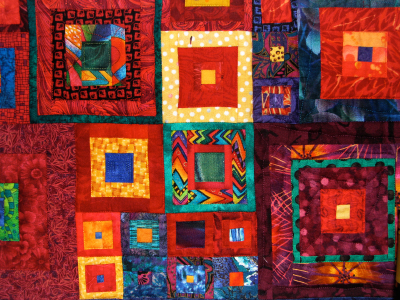
February’s theme will be “Quilt.”
My friend Jeanne confirmed that a quilt is made of a top layer, the batting (which I called the stuffing), and the backing.
Every week we will create the top layer of written fragments, beautiful scenes to be stitched together into a more beautiful whole.
We will start with the backing, or the framework, the narrative arc (Week 1)
The stuffing is next: persons (Week 2) and voices (Week 3).
Finally we’ll put it all together (Week 4).
Please email me with any questions.
Hope to see you Wednesday!
January 2012
A lot of us are memoirists, and sometimes our personal stories can veer into the ditch of “and then, and then,” reading more like journals than narrative.
This month we’ll focus on ways to use fiction writers’ techniques
- to increase drama and emotion
- to improve pace and timing
- to develop character
whether we’re writing fiction or memoir.
We’ll write together based on prompts and then read aloud, offering supportive responses. At any time, writers are welcome to bring more polished work to the meeting for critique.
Wednesdays, January 4, 11, 18, and 25
6:30-8:30.
Miami Shores Community Center
$40 for residents/$50 for nonresidents
Writers meets every Wednesday from 6:30-8:30 p.m at the Miami Shores Community Center.
We are a supportive group of women writers–all genres and experience levels are welcome.
For more information, please email [email protected]
::
November 2011

Dear Writers,
November is almost here, and that can mean that we’re about to get swept into Thanksgiving dinners. Holiday shopping, decorating and entertaining. Traveling and/or hosting guests. General craziness–anything but writing.
And we all know from experience how well that works. If you’re like me, you may wind up on December 31 tired and creatively starved.
Why not something different this year? Something that puts your writing front and center in November, doing something you’ve been meaning to do all year?
Yes, I mean writing those 50,000 words you’ve been meaning to get around to. To help all of us accomplish that, Shores Writers will be doing NaNoWriMo together in November!
In case you’ve never heard of NaNoWriMo, I’ve cut and pasted the basics from their site.
From the NaNoWriMo site:
National Novel Writing Month is a fun, seat-of-your-pants approach to novel writing. Participants begin writing on November 1. The goal is to write a 50,000 word, (approximately 175 page) novel by 11:59:59, November 30.
Valuing enthusiasm and perseverance over painstaking craft, NaNoWriMo is a novel-writing program for everyone who has thought fleetingly about writing a novel but has been scared away by the time and effort involved.
Because of the limited writing window, the ONLY thing that matters in NaNoWriMo is output. It’s all about quantity, not quality. This approach forces you to lower your expectations, take risks, and write on the fly.
Make no mistake: You will be writing a lot of crap. And that’s a good thing. By forcing yourself to write so intensely, you are giving yourself permission to make mistakes. To forgo the endless tweaking and editing and just create. To build without tearing down.
As you spend November writing, you can draw comfort from the fact that, all around the world, other National Novel Writing Month participants are going through the same joys and sorrows of producing the Great Frantic Novel. Wrimos meet throughout the month to offer encouragement, commiseration, and—when the thing is done—the kind of raucous celebrations that tend to frighten animals and small children.
In 2010, we had over 200,000 participants. More than 30,000 of them crossed the 50K finish line by the midnight deadline, entering into the annals of NaNoWriMo superstardom forever. They started the month as auto mechanics, out-of-work actors, and middle school English teachers. They walked away novelists.
So, to recap:
What: Writing one 50,000-word novel from scratch in a month’s time.
Who: You! We can’t do this unless we have some other people trying it as well. Let’s write laughably awful yet lengthy prose together.
Why: The reasons are endless! To actively participate in one of our era’s most enchanting art forms! To give yourself permission to write without obsessing over quality. To be able to make obscure references to passages from our novels at parties. To stop being one of those people who say, “I’ve always wanted to write a novel,” and become one of those people who can say, “Oh, a novel? It’s such a funny story–I’ve written three.”
When: You can sign up anytime to add your name to the roster and browse the forums. Writing begins 12:00:01 November 1. To be added to the official list of winners, you must reach the 50,000-word mark by November 30 at 11:59:59. Once your novel has been verified by our web-based team of robotic word counters, the partying begins.
We’re going to play a little bit fast and loose with the fiction/nonfiction distinction–our sole goal will be to write 50,000 new words (each of us!) between November 1 and November 30.
So sign up for NaNoWriMo online–it’s free–then sign up at the Miami Shores Community Center for Shores Writers in November–it’s nearly free–and start writing!
::
Shores Writers Continues in October 2011
Join us on Wednesday October 5, Wednesday October 12, Tuesday October 18, and Wednesday October 26, from 6:30-8:30 p.m.
In September, we worked on using the prompts and our weekly meetings to build larger pieces of memoir. Participants produced some fine work, and could see their larger projects taking shape.
In October we’ll continue with this format–I hope you’ll join us.
::
September 2011
Even if “after Labor Day” doesn’t mean that you can’t wear white again until Memorial Day, or that you’re going (or sending someone else) back to school, this time of year does mark the re-starting of Wednesday night Shores Writers workshops at the Community Center.
I’ve given “Shores Writers” a subtitle: “A Women’s Writing Circle.”
Beginning September 7, we’ll be officially women-only. Since its inception in January of this year, with one brave exception,all the members of the Miami Shores Writing Workshops have been women, and we’ve created a circle of trust and freedom and openness that I want to acknowledge and cultivate.
If you’re reading this and you’re a man, please consider passing it on to a woman you know. And please keep writing, and email me if you want to find another writers’ group in Miami; I can send you some leads.
We’ll meet every Wednesday night (except Thanksgiving Eve) between September 7 and the end of the year.
The cost is $50/month for Miami Shores residents and $62.50/month for nonresidents.
If you’ve never done a workshop with me, please check out my blog at www.angelakelsey.com/workshops to see some examples of the kind of writing we’ve done in the past.
We’ll continue to write and read aloud as much as we can in two hours, based on prompts I will provide.
The theme in September will be Memoir: Getting Started, and we’ll take October, November, and December as they come, depending on the interests and requests of the group.
::
Summer 2011
And if you need a little more, or a little less, please join us in Miami Shores for three stand-alone Saturday morning workshops: July 9, July 23 and August 13, 9 a.m.-noon.
We’ll be writing about summer–in all its Miami glory.
5 weeks at the Miami Shores Community Center
Begins June 1 (Wednesday) and continues June 9 (Thursday), then (back to Wednesdays) June 15, 22, and 29. 6:30-8:30 p.m.
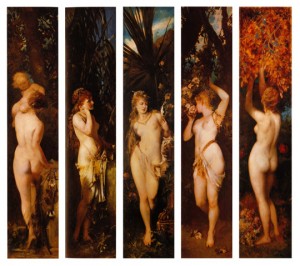
- The Senses by Hans Makart
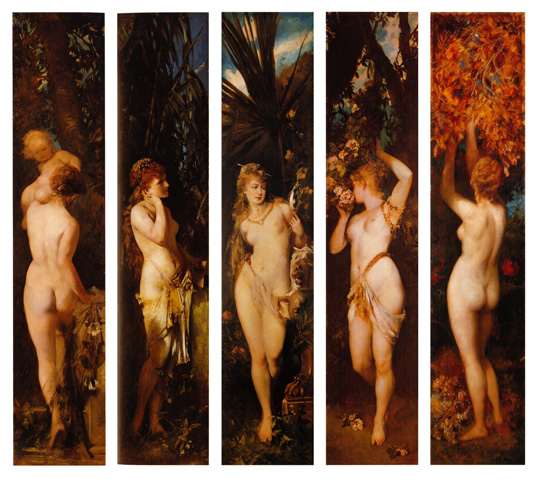
Writing the Five Senses
I’m smitten with Diane Ackerman’s Natural History of the Senses, and we’ll be drawing inspiration from it for (at least) five weeks.
Week 1: Sight
Prompts:
- Spend 15 minutes wearing a blindfold. Walk outside with a partner if possible. Be aware of how your “other” senses are heightened when you cover your eyes. Touch things, sniff the air, listen.
- Write for 10 minutes on various colors–what they remind you of, memories they bring up.
Week 2: Touch
Prompts:
- Write for 10 minutes about a vice or beloved pastime, in terms of touch.
- Write for 10 minutes about an experience with a professional “toucher”–a doctor, a hairdresser, an aesthetician, a massage therapist.
- Write for 10 minutes about how a germaphobe thinks of touch.
- Write for 10 minutes about a memorable kiss.
Week 3: Hearing
Prompts:
- Ackerman: “Music, the perfume of hearing, probably began as a religious act, to arouse groups of people.” Let us get to know a character through her favorite music.
- Ackerman: “We rarely hear the inner workings of our bodies.” Write about a time when you were (maybe a little too, uncomfortably) aware
Week 4: Smell
Prompts:
- Write for 10 minutes about a person with a distinct smell.
- Write for 10 minutes about the worst smell you can think of.
- Write for 10 minutes about a smell that evokes a memory.
Week 5: Taste
Prompts:
- Write for 10 minutes about a taste that you can’t recreate, no matter how hard you try.
- Write for 10 minutes about food as a means of seduction.
- Write for 10 minutes about food as an alternative language, a way of expressing the unexpressable.
Each week we will write in class as well as share work written and edited between sessions.
Come join a lively group of writers–all genres and experience levels welcome.
To register, call the Community Center at 305-758-8103 or join us on the first night.
Beginning April 2011 in the Shores:
For Week 1, on Point of View, here’s a post from Men with Pens.
And if you think you can’t write memoir from the second-person point of view, check out Much to Your Chagrin.
And third person is also a rarely used option: Against the Grain.
For Week 2, we’ll focus on Character, using this exercise.
For Week 3, we’ll focus on Dialogue and also a little grammar.
Week 4 will be all about Setting.

New workshop at the Miami Shores Community Center starts March 2!
We’ll meet on the five Wednesday nights of March: 2, 9, 16, 23, and 30, from 6:30-9 pm.
We’ll be focusing on some “basics”–Plot, Setting, Character, and Dialogue–as well as daily writing, in-class writing, and workshopping student work.
Resources:
Peter Guber on The Art of Purposeful Storytelling
Stephen King Excerpts on Plot, Dialogue, Character, and More
Tommy McSummary Video on Plots in Mel Gibson Movies
Mary Carroll Moore’s list of books to learn from and enjoy
Jane Friedman on Showing and Telling in Dialogue
Dialogue Tips from The Blood-Red Pencil
From the New Yorker: A Cure for Blocked Screenwriters
Joyce Carol Oates on character
In January, 2011, I’ll be teaching at the Miami Shores Community Center:
Does this look like your 2011 New Years Resolution list?
√ Write the great American Novel
√ Finish that memoir
√ Share your family history
√ Launch your blog
Turn your resolutions into reality and join me at the Miami Shores Community Center for a five-week writing workshop beginning Wednesday, January 19, 2011, at 6:30 p.m.
For more information, call the Community Center at 305-795-2241.
We’ll divide the five weeks’ workshop time and writing assignments this way:
Week 1: Beginning the Writing Process: prompts, morning pages, brainstorming
Some resources: Joanna Paterson on Developing a Writing Practice
I’m Only Really Having Fun When I’m Writing
Week 2: The Importance of Consistency: the daily care and feeding of a writer
Cynthia Morris on the Benefits of Daily Creative Practice
Law and Fiction: Getting the Facts Straight
Week 3: Breaking it Down: revision and polishing
Performing Surgery Without Anesthesia
Week 4: The In-Between: back to the drawing board and filling in the gaps
The Rumpus Interview with Nick Flynn
Graham Strong on the Second Draft of the Novel
Week 5: Putting it All Together: finishing a piece of writing, and what to do with it
Alison Bechdel interview from Wag’s Revue
New Yorker review of J. R. Ackerley’s Memoirs
In Fall, 2010, I taught at the Florida Center for the Literary Arts.
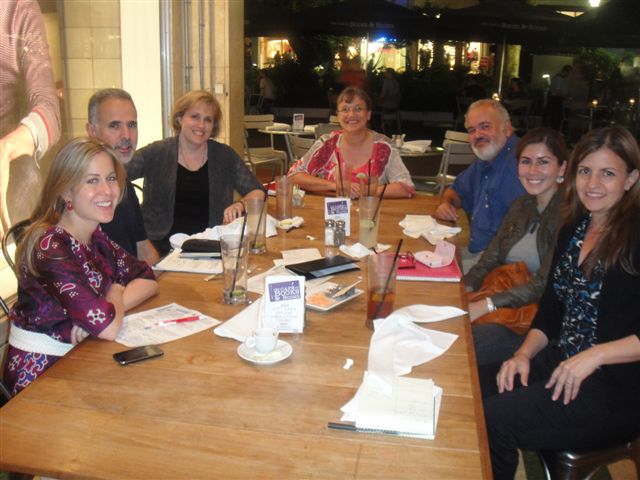 Here’s what one student said about the class:
Dear Angela,
I want to thank you again for your effort and guidance during your course “Place”. The time you took in preparation and your constructive feedback were invaluable. Personally, I felt supported in what was for me an important serious first step into the creative writing process. I have the curse of the dilettante, you know, and this course helped focus a years long yearning into a reality. You have a genius for applying just the right amount of pressure to make us write and the consideration given to each student each week stimulated our imaginations. I would look forward each week to someone’s, if not necessarily my own, fresh creative production. I also think you opened up the group and fostered a spirit of support and collaboration. I hope you will continue to teach at FCLA. See you in Jan.
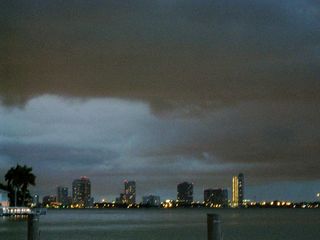
The class was called “Beginning with Place: How to Research and Create Setting.”
Here’s some of what we talked about:
What is the function of place/setting in fiction and nonfiction writing?
What are your favorite examples of writing about place? Why do you like them? How do they serve the work, fiction or nonfiction, that you’re reading?
What are some of the ways our minds remember place? Now I’m listening to Pat Metheny Radio. How does music evoke place and how can we model music’s techniques in our writing? For a great site about writers and their playlists, check out the music blog Largehearted Boy: Book Notes.
What happens in your memory and imagination when you think of a place? Do you use other senses as well? I took the picture above on a recent evening walk across the Venetian Causeway in Miami Beach. I could write about how the air felt, what I smelled, the taste of the water I drank, the sounds of thunder and water and traffic. What role do the senses play in memory and imagination about place?
In A Lie That Tells the Truth, John Dufresne writes,
Place connects characters to a collective and a personal past, and so place is the emotional center of a story. And by place, I don’t simply mean location. A location is a dot on a map, a set of coordinates. Place is a location with narrative, with memory and imagination, with a history. We transform a location to a place by telling its stories.
The syllabus: Download Beginning with Place
Week 1 Starting Points: A Map in-class reading: Download Mary Karr Liars’ Club and Download Rick Bragg Prince of Frogtown.
Week 2 Where I’m From in-class reading: Download Kathleen Norris Dakotaand Download Cormac McCarthy Blood Meridian.
If you want more on McCarthy and place, here’s an article from Writers Chronicle: Download Matrix for Meaning.
Also, regarding revision, take a look at this blog post by Alice Elliott Dark.
In class, we’ll be working on our own versions of George Ella Lyon’s “Where I’m From.”
Week 3 Internet: A New Frontier in-class reading: Download Patricia Engel Vida and Download The Importance of Place and Download Tobias Wolff This Boy’s Life.
Regarding research in general, this quote from Zora Neale Hurston:
“Research is formalized curiosity. It is poking and prying with a purpose. It is a seeking that he who wishes may know the cosmic secrets of the world and they that dwell therein.” (via www.reckon.posterous.com)
Also, regarding internet research, the following links:
Exploring Government Documents
Is the Internet Killing Proper Research?
Week 4 Field Trip in-class reading: Download William Zinsser On Writing Well and Download Carolyn See Making a Literary Life.
Links:Michael Cunningham’s Found in Translation
Michael Cunningham’s Advice for Young Writers
Amy Knichols Observe the World
How Handwriting Boosts the Brain
Week 5 Interviews and Photographs in-class reading: Download Eudora Welty On Writing and Download FAULKNER-Wild Palms-Placeand Download Dorothy Allison The Writer’s Notebook.
Links: Jen Louden on the Discovery Draft
Week 6 Senses and Setting Reading: Download Calvin Trillin from Feeding a Yen and Download MFK Fisher from The Gastronomical Me
Links: OneWord.com
The Rumpus Interview with Maile Meloy
Week 7 Music Reading: Download From Annie Dillard’s Pilgrim at Tinker Creek and Download Alexander Chee from Mentors Muses & Monsters
Links: Annie Q. Syed on music.
Week 8 Loose Ends